The Best Clay Alternatives in 2026 (Compared)
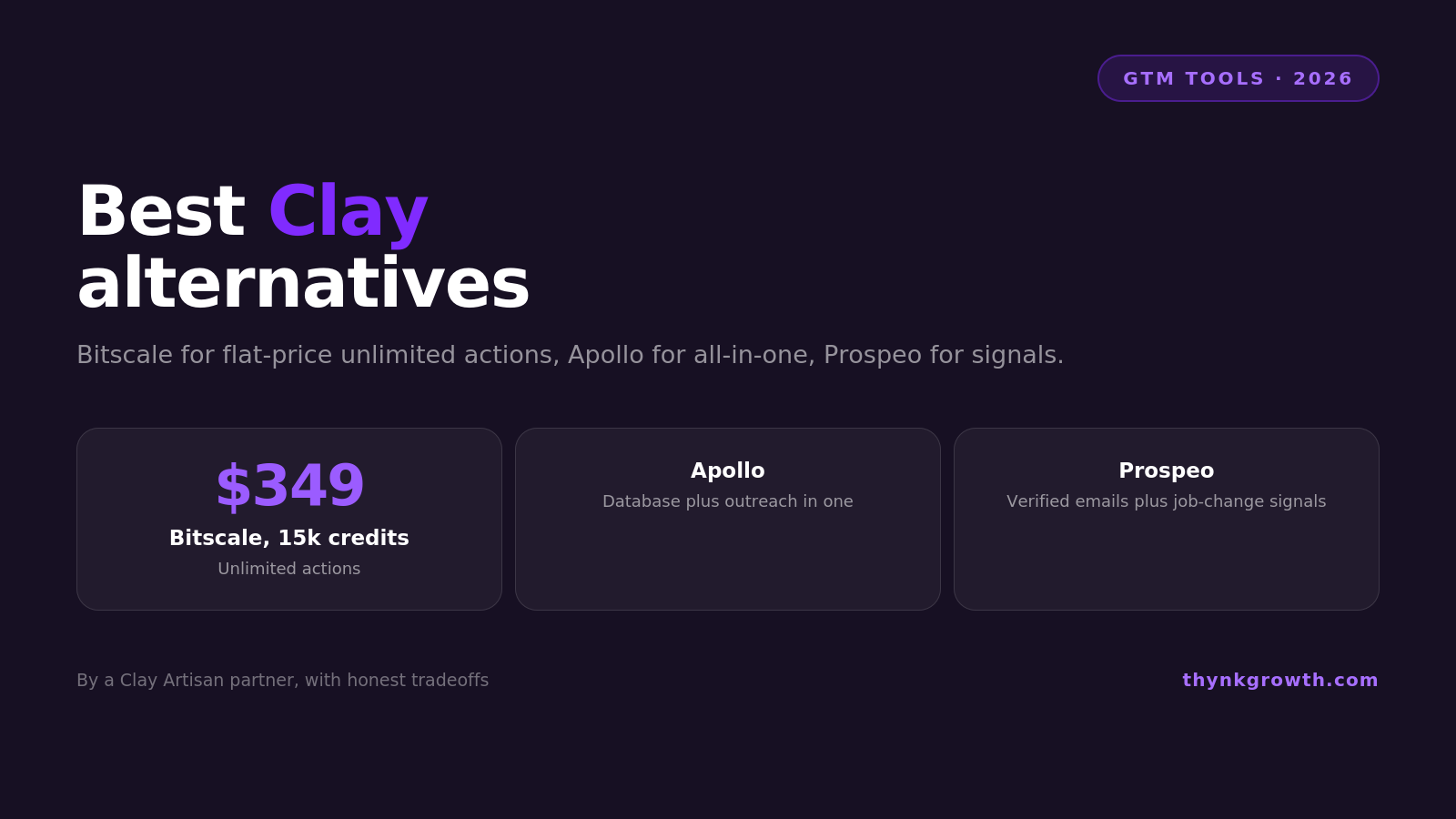
The best Clay alternatives in 2026 are Bitscale for unlimited-action enrichment at a flat price, Apollo for an all-in-one database and outreach tool, and Prospeo for focused email finding and signals, with ZoomInfo and Cognism as the enterprise-data options. Most teams start looking for a Clay alternative for one reason: after Clay moved to a model that meters action credits on top of data credits, heavy workflows got more expensive, and a busy GTM team can burn through credits fast. Below is how I would choose, written as someone who uses Clay every day.
I am a Clay Artisan Solutions Partner with all four certifications, and I was the sole Clay operator building enrichment workflows at an enterprise procuretech SaaS company before running ThynkGrowth. I am not anti-Clay. Clay is still the most powerful orchestration layer on the market. But powerful and right-for-you are different questions, and for some teams a simpler or flat-priced tool wins.
Bitscale: the flat-price, unlimited-action option
Bitscale is the clearest answer for teams that felt the sting of action credits. It is 349 dollars for 15,000 credits with unlimited actions, so you are not metered on every workflow step. It runs waterfall enrichment across 100 plus providers for 90 percent plus email coverage and 95 percent plus mobile coverage with verification baked in, and it is CRM-native with two-way Salesforce and HubSpot sync that flags CRM rot like job changes and dead domains. If your Clay bill is climbing because of action credits, this is the first alternative to test.
Apollo: database and outreach in one
Apollo is a different shape of tool. Instead of orchestrating other providers, it owns a large B2B database and bundles sequences and dialer on top, from a free plan up to 149 dollars per user a month. If what you actually wanted from Clay was contact data plus a way to reach people, Apollo does both in one place at a lower entry price. It is not an enrichment orchestration layer, so it will not run complex waterfalls, but for many teams that is more tool than they need.
Prospeo: focused finding and signals
Prospeo is the pick when your real need is verified emails and job-change signals rather than a full platform. It detects a job change and returns the person's new role, new company, start date, verified email, and LinkedIn URL in one step. For a signal-led motion built around timing, that is often more useful than a general enrichment stack.
ZoomInfo and Cognism: the enterprise-data lane
If your bottleneck is data depth and coverage, especially outside North America, ZoomInfo and Cognism are the enterprise options, both quote-based rather than self-serve. They are expensive and contract-heavy, but for large teams that need compliant, high-coverage data at scale, they are the serious alternatives to building it yourself in Clay.
The honest tradeoff
Here is the against-interest truth: for teams building genuinely custom, multi-step enrichment and AI research workflows, nothing replaces Clay. Its 150 plus provider marketplace, Claygent AI research, and signal features are still best in class, and if you have someone who can operate it, the action-credit cost is worth it. Switch only if you are paying for power you do not use, or if a flat-price tool like Bitscale covers your real workflows. If you would rather not operate any of these yourself, we run the enrichment layer for clients as part of their GTM infrastructure.
What is the best alternative to Clay?
It depends on the need. Bitscale is the best alternative for flat-priced, unlimited-action enrichment. Apollo is best if you want a database and outreach tool in one. Prospeo is best for verified emails and job-change signals. ZoomInfo and Cognism are the enterprise-data options.
Is there a cheaper alternative to Clay?
Yes. Bitscale at 349 dollars for 15,000 credits with unlimited actions avoids Clay's per-action metering, and Apollo starts free and goes up to 149 dollars per user a month. Whether they are cheaper for you depends on how many workflow actions you run each month.
Why are people looking for Clay alternatives in 2026?
Mainly cost. After Clay began charging action credits on top of data credits, high-volume workflows became more expensive, so teams running heavy enrichment started evaluating flat-priced tools. Clay remains the most powerful option, but not always the most economical.
Can I replace Clay with Apollo?
Sometimes. If you used Clay mainly for contact data and basic enrichment, Apollo can replace it and add outreach. If you used Clay for custom multi-step workflows and AI research across many providers, Apollo cannot match that orchestration and you would lose capability. ---
Related reading
Want this running for your pipeline?
Book a free strategy call. We map your outbound plan whether you work with us or not.
Book a free strategy call