Cold Email Case Study: Building B2B Outbound From Zero for an Australian D2C Brand (2026)
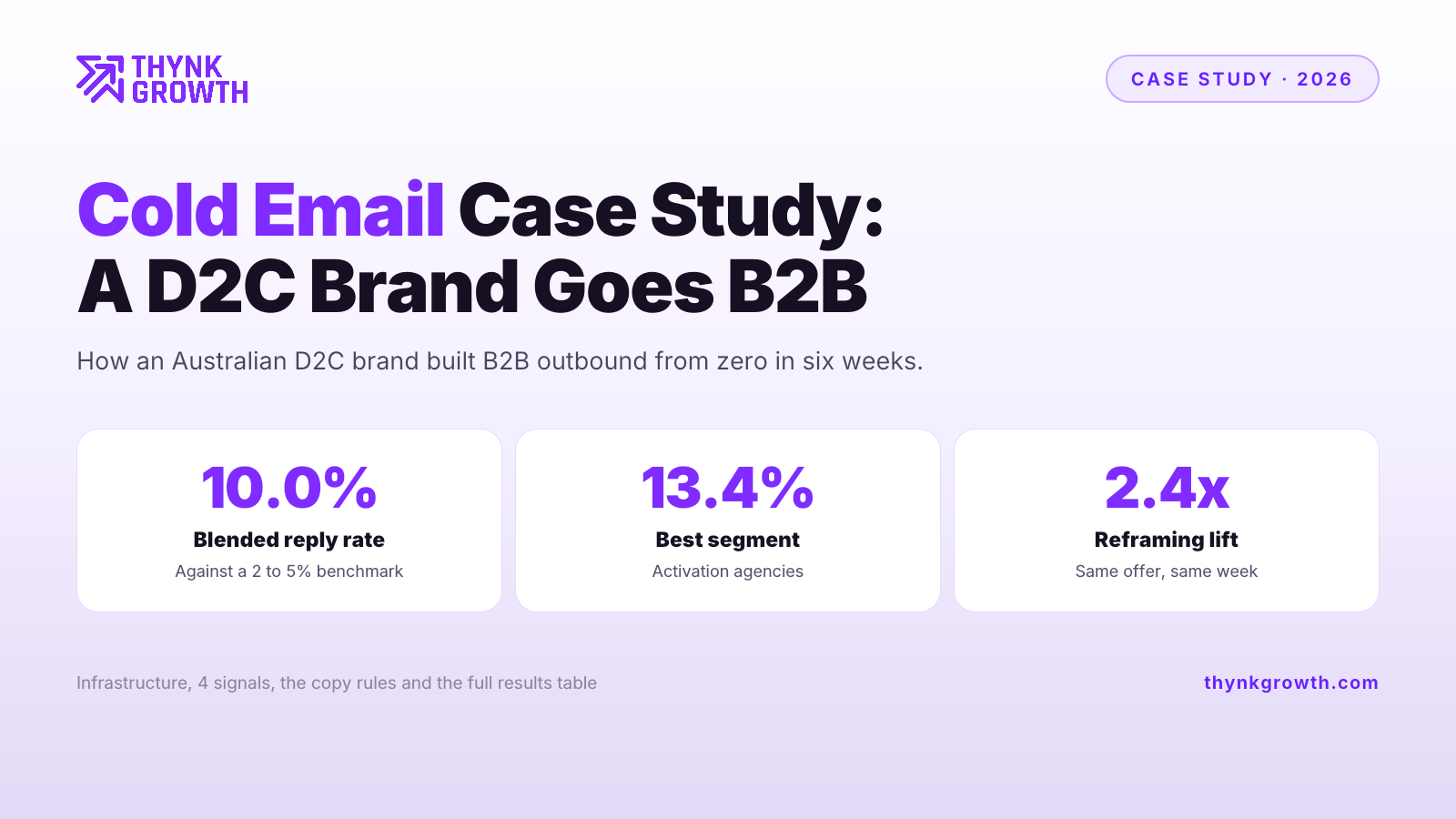
TL;DR: In six weeks of sending, from 14 September to 22 October 2026, we built a B2B outbound engine from scratch for an Australian D2C brand in premium home entertainment and games-room equipment. We reached 1,336 leads with 3,778 emails and got 134 replies: a 10.0% blended reply rate against a published cold email benchmark of 2 to 5%. The best segment, activation agencies, replied at 13.4%. Reply counts include out-of-office, so the human reply rate is lower, and 9 replies were positive. What moved the numbers was not volume. It was four buying signals, openers written from each lead's own work, and one positioning fix halfway through.
I run ThynkGrowth, a signal-led outbound agency based in Bangalore, India. We are a team of GTM engineers and a Clay Solutions Partner, and before ThynkGrowth I built the outbound engine behind a $6.12M quarterly pipeline for a 70-person BDR team at an enterprise SaaS company. That was outbound with a known market, a trained team and years of data. This engagement had none of that, which is why it is worth writing up.
The client: a D2C brand that was accidentally B2B
The client sells premium home entertainment gear to consumers in Australia, the kind of equipment that ends up in a games room or a home bar. The business was built on direct-to-consumer sales and has a large consumer customer base.
Hidden inside those orders was a second business nobody had gone looking for. Brands were asking for the same gear with their logo on it, bought in runs. They used the units as dealer rewards, trade incentives and competition prizes. One distributor had reordered 61 times. The B2B demand was real, it was just arriving by accident.
Why inbound could not reach these buyers
Nobody searches for a category they have never heard of. A trade marketing manager planning a dealer incentive does not type "branded games-room equipment" into Google. They default to what they always buy: polo shirts, gift cards, the bowl of lollies on the trade stand.
So inbound only ever reached buyers who had already thought of it. The client had two reps working purely inbound, a CRM built for one-off consumer transactions rather than a multi-touch B2B pipeline, and no outbound infrastructure, ICP, list or messaging. Outbound was the only way to reach the rest of the market, and all of it had to be built from zero.
The infrastructure: 30 mailboxes, 10 domains, built in the client's name
Everything was set up in the client's own accounts, so they own the domains, mailboxes, data and campaigns whatever happens next.
- 30 mailboxes across 10 secondary domains, never the main company domain
- 3 mailboxes per domain, roughly 90 sends per domain per day, which keeps every domain under the 100-a-day threshold
- 14 days of warmup before any cold email went out
- Smartlead as the sending platform
We split the mailboxes into two tracks. Track 1 used 10 mailboxes under the founder's name for high-signal campaigns, with email and LinkedIn together. Track 2 gave 20 mailboxes to the reps for a volume segment, email only until someone replied. If you are sizing your own setup, the mailbox calculator does the same arithmetic, and how many mailboxes you need for cold outreach explains the rules behind it.
Four campaigns, four buying signals
A filter tells you who could buy. A signal tells you who has a reason to answer today. Every campaign was built on a signal with a deadline attached:
- Fresh budget. A new marketing manager, 30 to 60 days in the seat, with budget that is not committed yet.
- Black Friday. Brands that ran a promotion last year. The date is locked, the prize is not.
- Dealer incentive. A conference that has just been announced. The reward is usually the last thing signed off.
- Date locked. Companies on a trade show exhibitor list, with a fixed deadline and a named owner.
If signal-led outbound is new to you, what a signal-led outbound agency does covers the model in more depth.
The copy rules: lead with the mechanic, never the product
The rule we wrote on day one: if a line could have been written by any supplier in any category, it is the wrong line. Every first email:
- Opened on the lead's problem, not on the product
- Stayed under 80 words, in plain text
- Had no links and no meeting ask
- Used Australian spelling and contractions, a banned-words list, and no hedging
No two campaigns shared an opener, a second line or a closing question. That is good for replies and it matters for deliverability, because repeated sentence patterns across thousands of emails are exactly what spam filters fingerprint.
The results: four campaigns, six weeks of sending
| Campaign | Leads | Sent | Replies | Reply rate | Positive |
|---|---|---|---|---|---|
| Trade brands | 443 | 1,267 | 46 | 10.4% | 4 |
| Activation agencies | 411 | 1,139 | 55 | 13.4% | 3 |
| Black Friday, broad | 389 | 1,115 | 21 | 5.4% | 1 |
| Black Friday, variant | 93 | 257 | 12 | 12.9% | 1 |
| Total | 1,336 | 3,778 | 134 | 10.0% | 9 |
Source: Smartlead, 14 September to 22 October 2026. Reply counts include out-of-office replies, so the human reply rate sits below the headline.
Three things the data told us:
- 10.0% blended reply rate, two to five times the 2 to 5% benchmark, from a brand with no prior presence in the market it was writing to.
- Activation agencies were the sharpest wedge, and it held. One agency won brings its whole roster of brands with it. Agencies serving hospitality and alcohol clients replied at an even higher rate.
- Same offer, same week, different framing: 2.4 times the reply rate. The broad Black Friday campaign replied at 5.4% and the variant at 12.9%. The variant was only 93 leads, so treat it as directional, but it points the same way as everything else.
Why agencies replied: every opener came from their own work
The activation agency openers were not personalised with a merge field. Each one was written from a campaign the agency had actually run:
- An agency that gave away a Kombi van and holidays for a soft drink brand got: "Good prizes. None of them had the brand on them."
- An agency that ran camera giveaways at trade events for camera retailers got: "The prize was a camera. To a room of people who sell cameras."
- An agency running a loyalty program that redeemed into prepaid and gift cards got: "It worked. Gift cards are still gift cards."
No two sequences shared a first line. It is slower than a merge field, and it is the reason this segment led the engagement.
The mid-flight correction
Partway through, the client flagged that our messaging had drifted. Some copy was starting to read as if they did fit-outs, installations or stand builds. They do not. We rewrote the positioning around one sentence: branded units, bought in a run, with the client's logo on every one, given away as prizes and rewards. Nothing we turn up and construct.
The campaign that followed that rewrite produced the best numbers of the engagement. Catching that drift quickly was worth more than any copy test we ran.
What we would do differently
The honest part. Nine positive replies from 1,336 leads is a real start, not a pipeline you can bank. A 10% reply rate that includes out-of-office replies flatters the headline, which is why we publish the positive column next to it. The broad Black Friday campaign was the weakest at 5.4%, and the reframed variant on the same offer more than doubled it. And the variant that beat it ran on a small sample.
If we ran it again, we would put more of the volume into activation agencies from week one, tighten the Black Friday signal before launch, and lock the positioning sentence in writing before the first email went out rather than after the drift.
Where it stands now
The client scaled on evidence, not instinct:
- 3x weekly volume, from 450 leads a week to 1,000 to 1,500, with LinkedIn running alongside
- 4 segments tested, 1 clear winner, with a sharper sub-segment inside it
- Positive replies route to the client's own reps, who work them in their CRM
The bigger change is that B2B conversations can now be started on demand instead of waited for.
Lessons you can take from this
- Look for the accidental B2B business inside your own orders. Repeat buyers, bulk orders and logo requests are a list of ICPs you have not named yet.
- Pick signals with a deadline. A locked date with an open decision is the strongest reason to reply.
- Write the opener from the lead's own work. It took longer and it won.
- Separate high-signal and volume tracks so a founder's mailboxes are not spent on broad lists.
- Publish your positioning in one sentence before launch, and check every campaign against it.
Working with an outbound partner in India
ThynkGrowth is a signal-led outbound GTM agency based in Bangalore, India. Our GTM engineers build outbound engines inside our clients' own accounts for B2B companies in Australia, the US, Europe and APAC: infrastructure, ICP, signal-based lists, messaging, and the rep workflow that turns replies into conversations. If you are weighing options, what a cold email agency does and how to choose one is a fair place to start, whoever you hire.
What reply rate should a B2B cold email campaign get in 2026?
A typical published benchmark for cold email is a 2 to 5% reply rate. In this case study, the blended reply rate was 10.0% across 3,778 emails, and the best segment reached 13.4%, though those counts include out-of-office replies.
Can a D2C brand use cold email to sell B2B?
Yes, if it already has B2B demand hiding in its orders. This Australian D2C brand found brands buying its products in branded runs for prizes and incentives, and outbound let it reach buyers who would never have searched for that category.
How long does it take to set up cold email infrastructure from zero?
Plan for about two weeks of warmup after the domains and mailboxes are bought. In this engagement, 30 mailboxes across 10 domains warmed for 14 days before the first cold email went out.
Does an outbound agency in India work with Australian companies?
Yes. ThynkGrowth is based in Bangalore and ran this engagement for an Australian brand, with copy written in Australian English and everything built in the client's own accounts.
Related reading
Want an outbound engine built like this one?
We build signal-led outbound inside your own accounts: infrastructure, signals, lists, copy and the rep workflow. Book a free strategy call and we will map your plan.
Book a free strategy call