Which Target Account Should You Work First? How Duo Accounts Answers It
Paid partnership with Amplemarket. I’m an Amplemarket partner. #ad
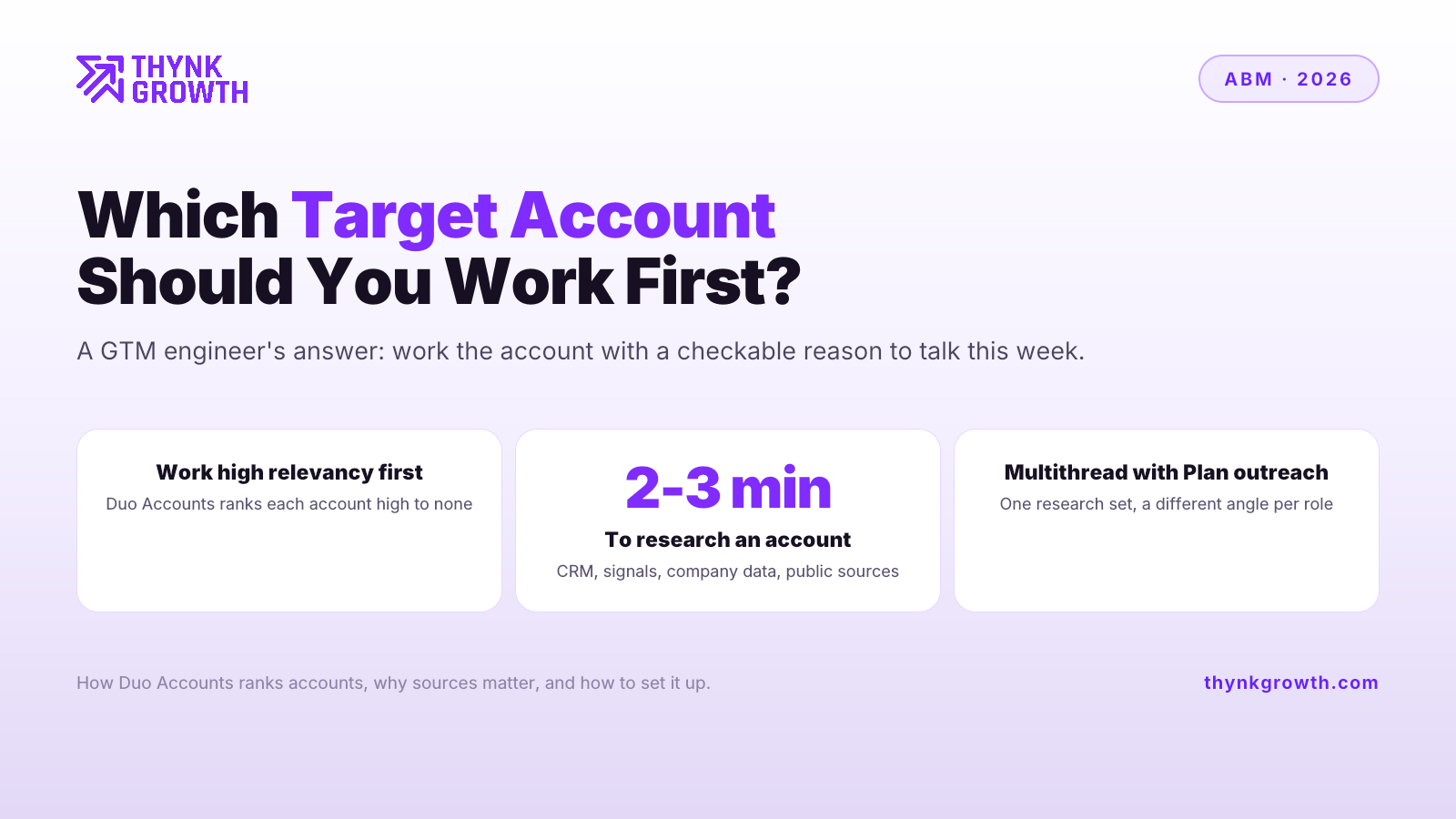
TL;DR: Work first the account that has a reason to talk to you this week, not the one with the best logo. Duo Accounts in Amplemarket researches every account you track, gives each one a relevancy level from high to none, and shows the source behind every reason. Start your day with the high accounts, multithread them with “Plan outreach”, and leave the “none” accounts alone until a new signal appears.
Every ABM team I have worked with says the same thing: we know we should research every account, and we never have time. So reps pick accounts by gut. They work the logos they recognise, or the ones they touched last week, and the account with the best reason to call sits on a list nobody opened.
I learned this the hard way. Before ThynkGrowth, I was a core team member on an autonomous ABM engine at an enterprise SaaS company that generated $6.12M in new pipeline in one quarter. The lesson I took away was not about sequences or copy. It was that account selection is the real bottleneck. When the right accounts reach a rep at the right moment, average messaging still books meetings. When the wrong ones do, great messaging is wasted.
What is Duo Accounts?
Duo Accounts is an account research agent inside Amplemarket. You track your target accounts, and it tells you which ones to work first, who to engage and why now, with the evidence behind every reason.
For each tracked account, it pulls from four kinds of source:
Your CRM: activity and notes on the account
Duo signals: the buying signals Amplemarket already tracks
Amplemarket company data
Public sources: news, job openings, social activity, G2 reviews, Slack communities and company blogs
A first run takes 2 to 3 minutes per account. The result lives in the account’s research view in Amplemarket, and a daily email and Slack digest covers up to five of your tracked accounts.
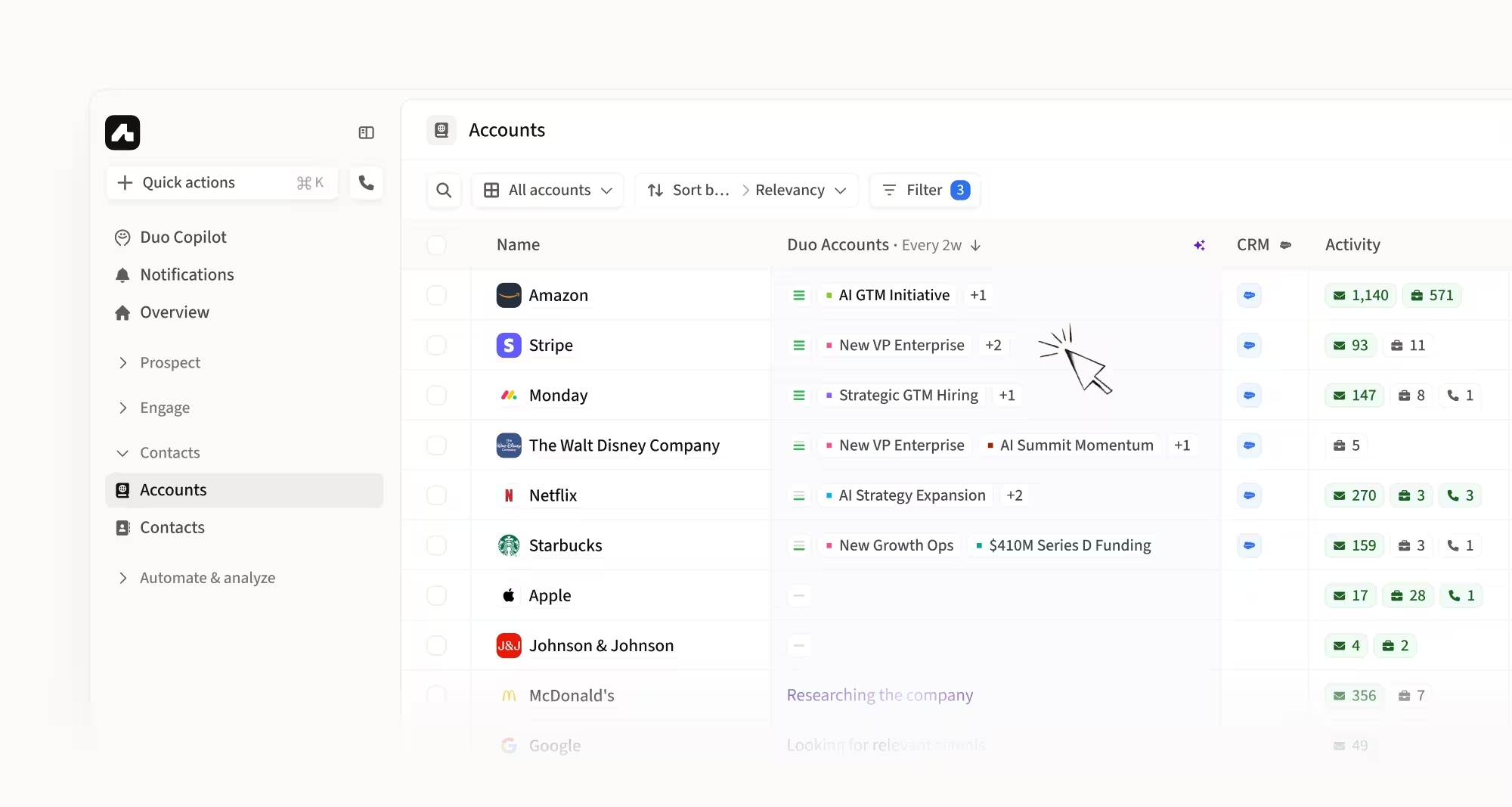
The screen above is the part I care about most. In the Accounts list, the Duo Accounts column sits next to CRM and activity data, and you can sort the whole list by relevancy. That turns “which account first?” from a gut call into a sorted list.
How Duo Accounts decides which account comes first
Each account gets a relevancy level: high, medium, low or none. Alongside it you get the reasons to engage, the signals behind each reason, and the source of each one.
Two things about this matter more than the ranking itself.
Every reason shows its source
When an agent tells a rep “this account is hot”, the first question is always “says who?”. In Duo Accounts, the research view shows how many sources were checked, which signals were found, and where each one came from. A rep can open the source and check it in seconds.
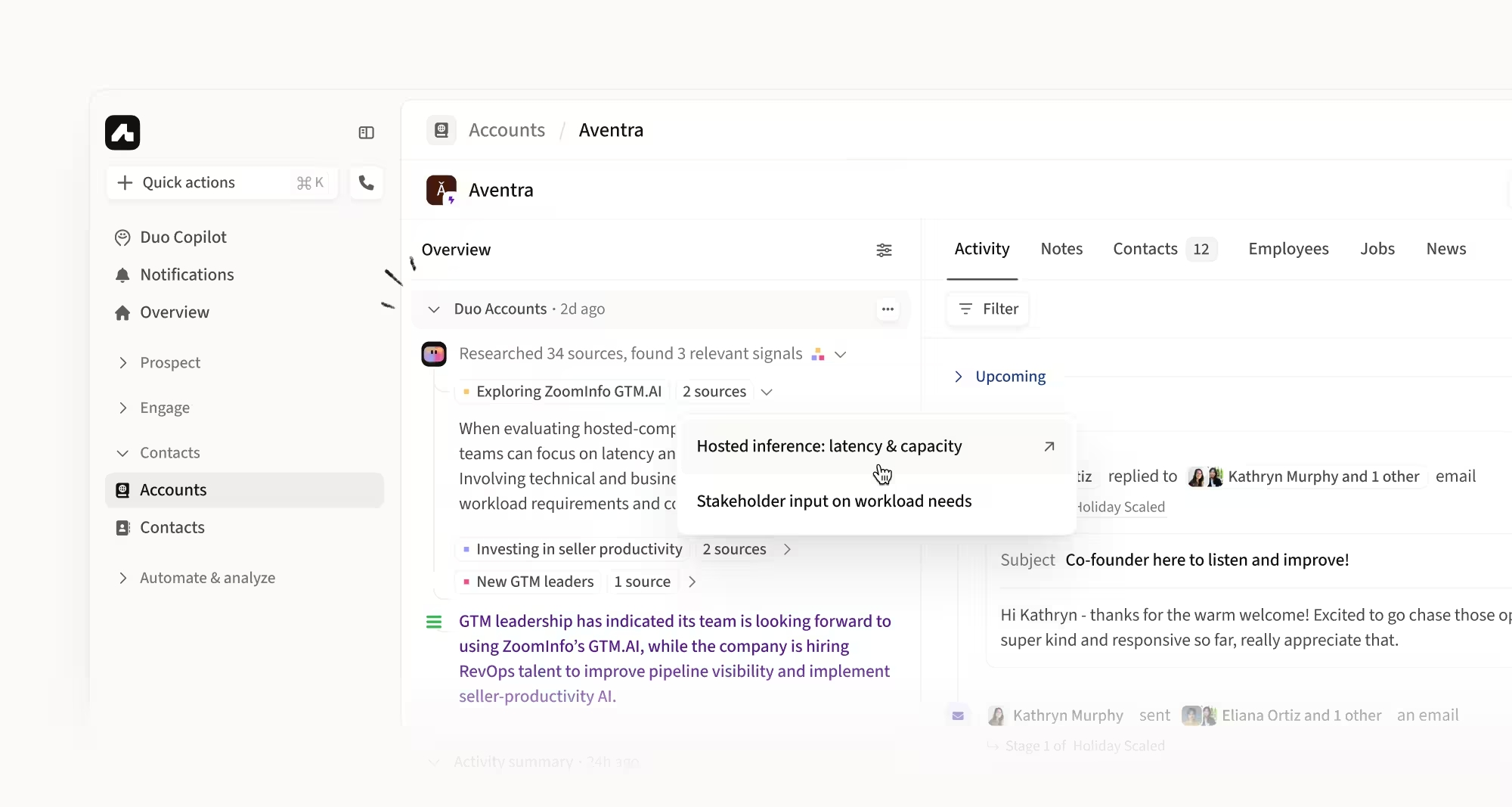
This is what builds trust in an agent. In my experience, reps do not ignore AI research because it is wrong. They ignore it because they cannot tell when it is wrong. Sources fix that.
It says “none” when there is nothing
This is my favourite design decision in the product. An account with no reason to engage shows “none”, not three padded reasons to keep the rep busy.
“None” does not mean the account is a bad fit. It means there is nothing worth acting on today. Your team can put its time where the timing is right, and come back when a new signal shows up. Most research tools I have used do the opposite: they always find something, and after a few weeks reps learn to skip all of it.
From research to a multithreaded plan
Picking the account is half the job. The other half is deciding who to talk to and what to say to each of them.
Duo Accounts has a “Plan outreach” button that sends the account’s research to your AI assistant through Amplemarket MCP. From the menu you can open it in Claude or ChatGPT, or copy the prompt. The assistant recommends the stakeholders to engage and an angle for each role, then helps turn that plan into a sequence.
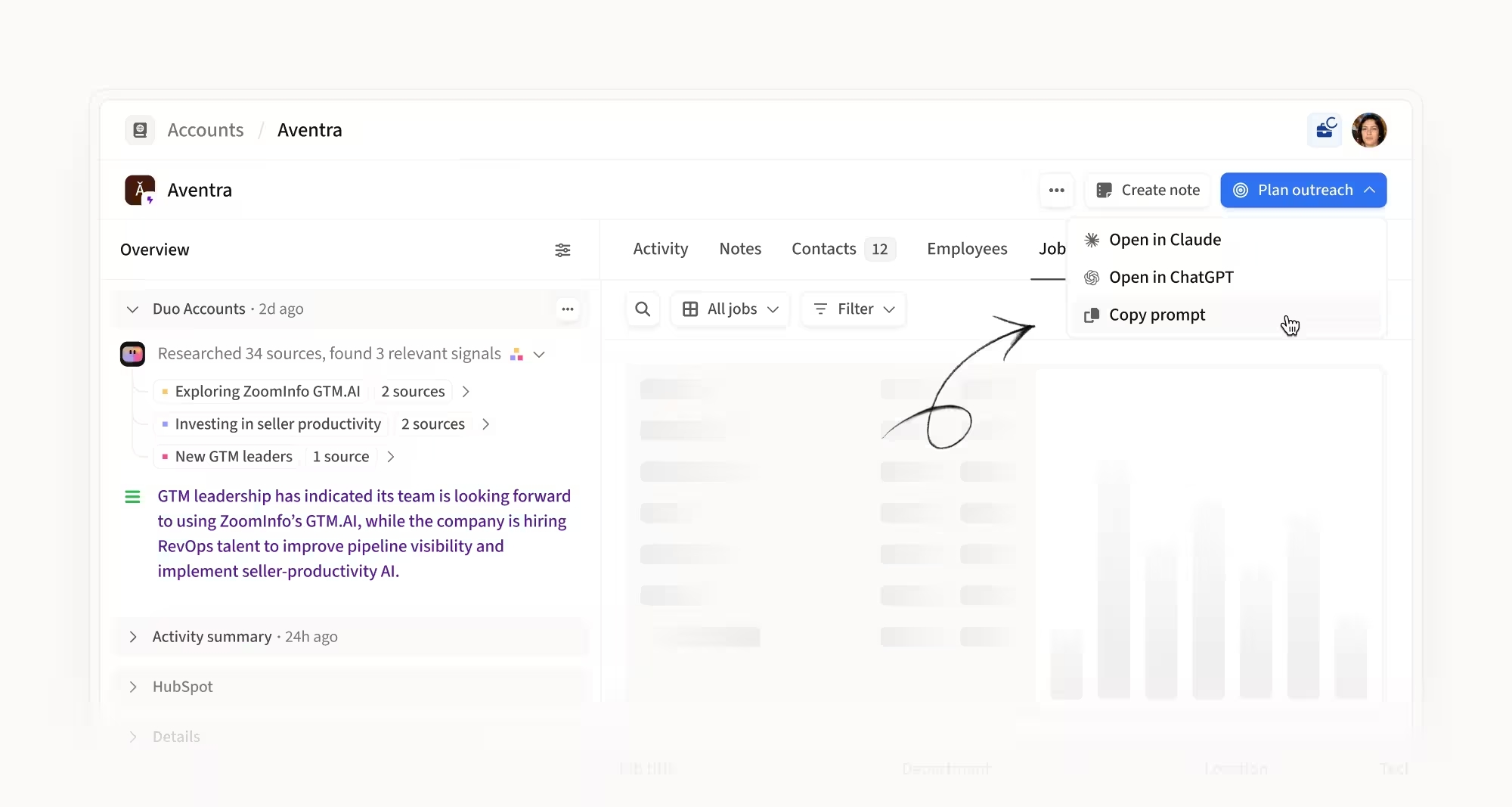
This is where account research pays off twice. One piece of research supports a different conversation with each person in the buying group. The VP of Sales hears about the hiring plan. The RevOps lead hears about the tooling change. The CFO hears about consolidation. Same account, same evidence, three relevant first lines.
How I would set it up for a client on day one
If I were rolling out Duo Accounts for a client tomorrow, this is the order I would follow:
Track a short list first. Start with 25 to 50 named target accounts, not the whole TAM. You want reps to read every research view in week one.
Make sure the CRM is connected and clean. CRM activity and notes are one of the sources, so the research is only as good as what your reps have logged.
Set up the daily digest. Route the email or Slack digest to the account owner, so the day starts with the top accounts instead of an inbox.
Work high first, medium second. Leave low and “none” alone unless the rep has a reason the agent cannot see.
Use “Plan outreach” on every high account. Multithread from day one rather than single-threading the most senior title.
Review after two weeks. Ask reps which reasons led to real conversations. That tells you which signals matter for your market.
What Amplemarket customers say about it
Two Amplemarket customers described it this way:
“This is exactly the tool I’ve been wanting. It’s basically like an intent dashboard - I can see what’s happening across my accounts, find the right people, and get them into a sequence without leaving the flow.”
An Amplemarket customer
“It’s surfacing things that would’ve taken me a long time to find on my own - the kind of research you know you should do on every account and never actually have time for. Now it’s just there, and it’s a great way to holistically understand which accounts are best to chase.”
An Amplemarket customer
Where it fits, and where it doesn’t
Duo Accounts fits teams with a defined list of target accounts: ABM programmes, enterprise and mid-market teams, and named-account territories. It is strongest when reps own a book of accounts and need to decide where to spend this week.
It fits less well if you sell high-volume, low-ticket deals with no named accounts. In that case, person-level signals, like the agents in Duo Copilot, will do more for you. And as with any research agent, it cannot fix a CRM nobody updates. Clean the data, then trust the ranking.
Try it yourself
If you want to see which of your target accounts deserve your time this week, you can book a demo or start a free trial of Amplemarket here. If you would rather have the account strategy and outbound engine built for you, that is the work we do at ThynkGrowth as an outbound GTM partner.
Which target account should I work first?
Work first the account with a current, checkable reason to engage, such as a new leader, a hiring push or a tooling change. Duo Accounts ranks tracked accounts as high, medium, low or none and shows the source of every reason, so you can start with the high accounts.
What is Duo Accounts in Amplemarket?
Duo Accounts is an account research agent. It researches each tracked account from your CRM, Duo signals, Amplemarket company data and public sources, then tells you which accounts to work first, who to engage and why now.
How long does Duo Accounts take to research an account?
A first run takes 2 to 3 minutes per account. Results appear in the account’s research view, and a daily email and Slack digest covers up to five tracked accounts.
What does a “none” relevancy level mean?
It means there is nothing worth acting on for that account today, not that the account is a bad fit. Your team can focus where the timing is right and return when a new signal appears.
Related reading
Want your accounts prioritised and set up for you?
We run signal-led outbound for B2B teams end to end. Book a free strategy call and we will map your plan.
Book a free strategy call